
A contract manufacturer, not a catalogue
Hangzhou Di Tong Biological Technology Co., Ltd. was founded in 2011 and manufactures cosmetics in Xiaoshan, Hangzhou. Meier Spa is the name the company trades under for export customers.
Company at a glance
Legal name: Hangzhou Di Tong Biological Technology Co., Ltd. Trading name: Meier Spa. Founded 2011. Location: No.1 Chunchao Road, Qiaonan District, Xiaoshan Economic and Technological Development Zone, Hangzhou, Zhejiang, China. Production sites: Hangzhou, Yuhang and Shanghai. Business: OEM and ODM cosmetics manufacturing across skin care, hair care, body care and colour cosmetics.
Company facts
The figures a buyer or a quality team usually asks for first, with the legal entity kept separate from the trading name so the two are not confused on a purchase order.
| Legal entity | Hangzhou Di Tong Biological Technology Co., Ltd. |
|---|---|
| Trading name | Meier Spa (meierspa.com) |
| Established | 2011 |
| Registered office | No.1 Chunchao Road, Qiaonan District, Xiaoshan Economic and Technological Development Zone, Hangzhou, Zhejiang, China |
| Production sites | Hangzhou, Yuhang and Shanghai |
| Production standard | GMPC-compliant cosmetics production base |
| Cleanrooms | 100,000-class and 10,000-class dust-free workshops |
| Formula library | More than 10,000 mature formulations |
| Categories | Skin care, facial cleansers and masks, essences, bath and body, hair care, colour cosmetics, freeze-dried powder and fragrance |
| Team | About 100 people across compounding, filling, QA and R&D |
| Export | Private-label manufacture for brand owners selling outside China |
| Contact | +86 186 9856 5558 · postmaster@meierskincare.com |
What the company actually does
The business is built around one promise: a brand owner should be able to arrive with a formula, a reference sample, or nothing but an idea, and leave with a filled, documented, export-ready product. That covers compounding and filling, but also the less visible work that decides whether a launch survives customs and a retailer's quality team: stability data, microbiological records, ingredient naming for the destination market, and artwork that will not be rejected at the border.
Product lines are organised by category rather than by machine. Skin care runs on the smaller, higher-accuracy lines where a 30 ml serum is filled; body and hair care run on larger volumetric equipment; colour cosmetics run on separate equipment because pigment cross-contamination is a real risk. A freeze-dried mask leaves the line as a dry sachet and is paired with an activator liquid only at packing.
The plant and the cleanrooms
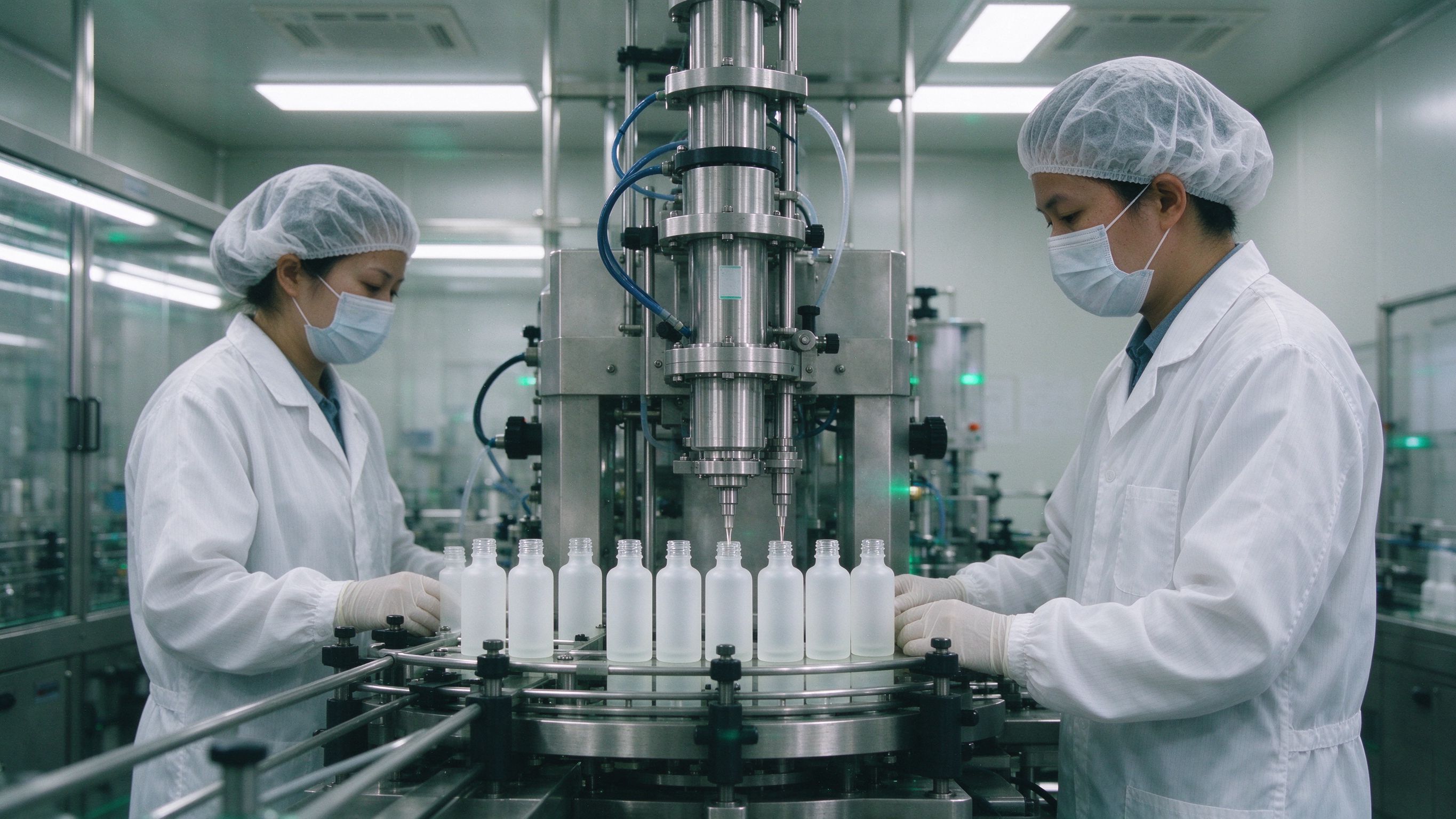
The production base was built to GMPC requirements, the Chinese cosmetics good-manufacturing standard, and runs 100,000-class primary filling rooms with 10,000-class secondary suites for open-product handling. Air is filtered and monitored, operators are gowned, and raw materials are staged through an airlock rather than walked in from the yard.
In practical terms the cleanroom class decides what can be made where. Open filling of a leave-on serum belongs in the higher-class room; sealed operations and secondary packing can sit outside it. That is also why the freeze-dried line is in the higher-class area: a dry product that will later be reconstituted on a customer's face cannot rely on preservatives for safety.
Formulation and the 10,000-formula library
The stock library is the commercial engine of an ODM business. More than 10,000 mature formulations are held on file, covering brightening serums, amino-acid cleansers, freeze-dried masks, scalp essences, body lotions, conditioners and colour products. Each entry carries a full ingredient list, a process sheet and stability history, so a new brief can often be answered with a tested formula rather than a fresh development project.
Development work is led by a PhD-level R&D team. When a client's brief cannot be met from the library, the team builds a match against the reference sample: texture first, then active dose, then scent, then the pack. A formulation that feels right but cannot survive your chosen bottle is not a finished formula, so pack compatibility is tested before the sample goes out.
Quality control, batch by batch
Every batch follows a documented route: raw material intake and identity check, compounding record, in-process checks on pH, viscosity and fill weight, then finished-goods testing before release. Bulk and finished product are both sampled for microbiological testing, and the filling rooms are monitored for airborne contamination.
Retention samples are kept for the shelf life of the product, so a complaint eighteen months after shipping can be checked against the actual batch rather than a specification sheet. Batch records link each raw material lot to the fill date, line and QA release signature.
How the company works with a new brand
Most first conversations are short. A brand owner describes the category, the selling market, the price band and the volume; the factory answers with two or three stock formulas, a realistic sampling date and the packaging options that fit the budget.
Nothing is quoted as a fixed price before the pack is chosen, because the pack is usually the largest variable in a private-label project. That is why sampling and packaging sourcing run in parallel: the sample tells you whether the product is right, and the packaging quote tells you whether the project is viable at your price point.
Questions about the company
Ownership, visits, certification scope and headcount, answered plainly.
Who owns the formula if we develop together?
It depends on the route. In ODM the factory owns the base formula and the brand licenses it, with adjustments written into the specification. In OEM the brand owns the formula and the factory manufactures under licence. If a formula is developed exclusively for one client, exclusivity is agreed in writing before development starts.
Can we visit the plant?
Yes, and we recommend it before a first bulk order. Visits are arranged through the contact form with a date and the number of attendees, so the cleanroom gowning and the line schedule can be prepared.
Is the company certified to ISO or GMP?
The production base operates to GMPC requirements with 100,000-class and 10,000-class cleanrooms. Certification documents for a specific standard should be requested in writing for the exact site and scope, because they are issued per facility and per audit cycle.
How many people work in production and QA?
Around 100 people across compounding, filling, quality assurance and R&D.
Ask for the document set
If your quality team needs certificates, stability records or a product information file before a first order, request them with the site name and the standard you work to.